
How to shoot a feature film with a tiny budget




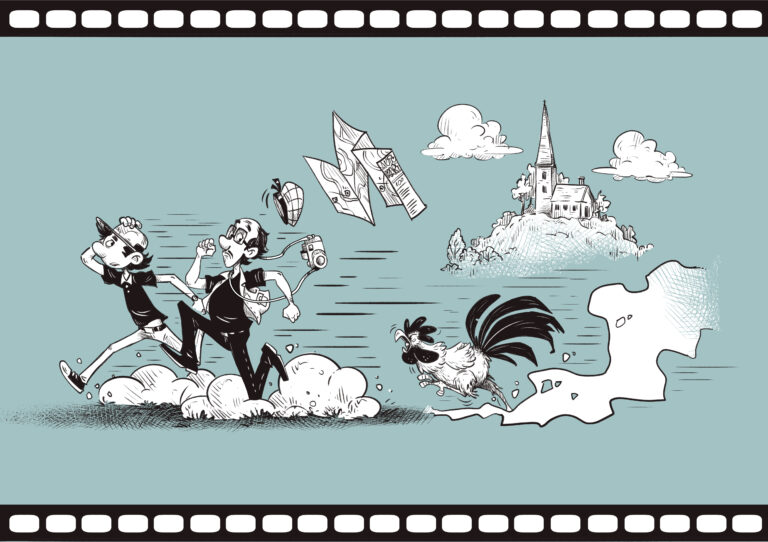
This isn’t a new-age piece. But if you’re asking how to shoot your first feature film with very little money, the answer is that it all comes down to attitude. And stories about attitude are new-age stories. So this is just another new-age piece after all.
So, which attitude?
The attitude is: WE’RE MAKING THIS FILM, 100%. Whatever gets in our way, we’ll deal with it, keep going and shoot the film on a shoestring. How do we know that’s true? Paulo Coelho and every new-age fable say so: when you want something, the whole universe conspires to help you.
Enemy number one
There’ll be enemies in your way who want to wreck your dream. The list: bad weather, broken equipment, illness sweeping through the crew — and the worst of all, your own doubt that the project will work. That doubt, or fear, also known as uncertainty or insecurity, kills everything beautiful.
Enemy number one is clever and cunning. It attacks the moment the idea appears that maaaaaybe we coooould shoot a film without much money. It uses tricks, sneaky and original ones. It’s a commando unit that slipped into your mind the moment you started thinking about pre-production. And it’ll present itself as rational, responsible thinking.
For example: when you do the sums and it’s clear you’re about 40% short of the budget you need to finish, fear will tell you, loud and clear, that you’re 40% short of the budget you need to finish. WHICH IS, OF COURSE, A LIE! A dirty lie.
…2 plus 2 isn’t 4, if 4 means we don’t shoot…
A partner
How do you beat fear? Find a partner to start pre-production with. The partner is completely committed to the project. That’s the one thing they must be. You split the tasks and each does their own. The partner is there to a) do their part and b) check you’ve done yours. Back and forth like ping-pong, a bit of it together, and voilà! The film’s in the can!
A coalition of the willing
What exactly do you and your partner do in pre-production? Look for people willing to make a film with you. You need a COALITION OF THE WILLING.
Where do you start? With the screenwriter.
You need a script, and for that you need a screenwriter who can write a good one, understands how tight the money is, and is still up for it. Their work and their willingness to go into pre-production are decisive. Their script, if it’s printed out, is the only tangible thing that exists at that point. But that’s more than enough.
Now begins the loveliest part of the whole process: imagining the film, drawing the storyboard, scouting locations, drawing a new and better storyboard, scouting better locations, imagining a better film… Meanwhile you’re looking for the rest of the crew who’d like to join.
The coalition of the willing is everyone involved in any way, from the people renting you a location to the camera crew and the cast. Of course, 99% of people won’t be thrilled to join a project for free or for pocket money. Their reasons don’t matter. What matters is finding the 1% who want to. That takes a bit more time and a lot of coffees, but it can be done.


Ready, steady, go!
Preparing with your coalition of the willing is more than worthwhile. The longer and better the prep, the fewer nasty surprises on set. You go through the script with the actors and the cinematographer, sometimes at home, sometimes on location. Things take shape. You start to see the outline of what it’ll be in the end.
The days count down, and then one morning it dawns: THE SHOOT BEGINS!

The shoot
That’s the end of fear and doubt. You’re shooting, and there’s no time to think about anything else. All the more so because it’s looking good. The last fear, the one crouched somewhere muttering that something will go wrong, has gone quiet. The actors are great. So are the cinematographer and the focus puller. And sound.
Now comes the sprint to the end of the shoot. Because of the limited budget, the shoot has to last less than two weeks. Somewhere after day six it’s clear that at this rate we’ll need a month. Time for changes. Which shots go, which stay?
What helps in the chaos is that three versions of the storyboard had been drawn and animated. (An animated storyboard, or animatic, is a storyboard laid out in time, with the length of every shot; there’s more in our storyboard article.) Because of all that repetition, every single shot is in your head. The shots are easy to review, analyse and, if need be, cut. We cut everything that isn’t essential.
That’s when the race really starts. Actors are first in line: from now on they get two, maybe three takes to give it everything — and somehow they manage it with ease. The days are long and hard, we stay later than planned every day, and it’s uncertain whether we’ll get it all shot. Everyone knows we’re racing the clock, but the crew’s commitment to the film is never in question.
On that shoot, for the first time in my life, I felt what long, unbroken adrenaline does to the mind. From day one I felt no tiredness, no hunger, no cold, and nobody got on my nerves. I felt great and nothing was too hard. We’re racing to get the film shot, and that becomes the only goal. When that’s your only focus, every other need disappears.
Situations come up that in normal life, life without that focus, would lead to endless arguing, justifying, persuading and hurt feelings. But with that focus and that goal, each one gets solved the fastest way possible. In that moment my opinions and feelings don’t exist; all that matters is how to fix it and get the shoot finished.
At that pace, with little sleep and lots of adrenaline, the shoot wraps.
After the wrap, you sleep.
After sleeping, more sleep.
And a bit more.

Sven Marić
Related topics: video production · Film.
Related reading


What can we do for you?
Your privacy choices
Choose whether to allow YouTube/Vimeo videos and Google Analytics. Both are optional. You can change your choices at any time.
How your choices work
YouTube and Vimeo videos load only if you allow external media. Their providers then receive your IP address and browser information and may use cookies. You can use the website and contact us without allowing them.
With your separate permission, Google Analytics measures visits and successful form submissions. Google receives technical visit information and, for known campaign links, the source, medium and campaign label. Advertising measurement and Meta Pixel are inactive. We remember your choices for 180 days; you can change or withdraw them at any time.