
Illustration drama aka let the illustrator do his job


Artistic illustration is a drawing or picture that interprets, adds to or decorates a text. There’s also documentary illustration — realistic plant drawings in an encyclopaedia, or the picture instructions for a washing machine — but here we’re talking about the artistic kind.
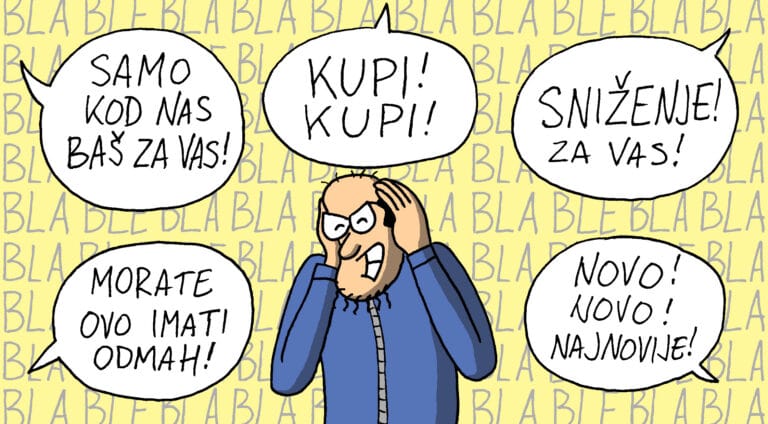
We’re all bombarded with information. It comes at us from posters, flyers, screens of every kind, speakers and who knows what else, all competing for our attention. If an image gives someone a reason to pause, the message has a better chance of getting through.
Which is where illustration comes in. As the saying goes, a picture is worth a thousand words. An illustration can get a message across very quickly and create the emotion that goes with it. One glance is literally enough. It doesn’t matter whether that emotion comes from colour, shape, composition or something else. That’s why illustration is such a useful tool today.

What’s illustration for?
In my work I’ve met plenty of people who aren’t sure what illustration is or what it’s for. I speak from experience, and I’ll illustrate the point with a conversation I’ve had more than once.
“What do you do?” I was asked.
“I’m an illustrator,” I replied politely.
“Oh! So you’re a designer,” my companion concluded, completely wrongly.
I’ve had conversations like that with people who don’t work in illustration, design or art in general. Still, it’s frustrating to see how easily an illustrator’s work can be overlooked or mistaken for something else.
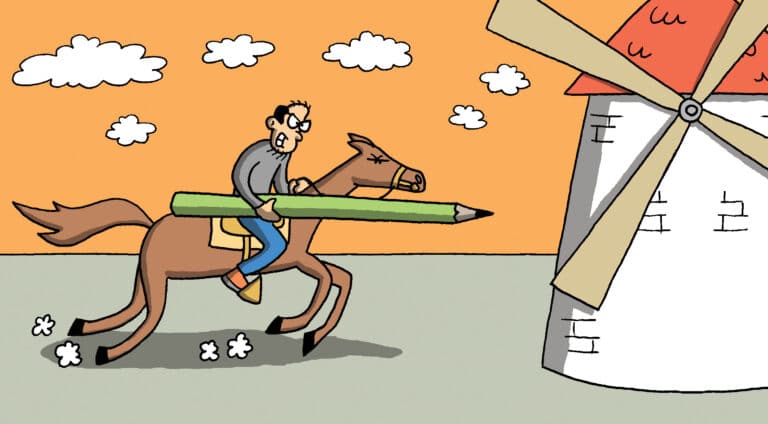
So illustrators spend half their careers explaining what they actually do and why it’s useful across all sorts of industries. If I may give younger colleagues one piece of advice: don’t tilt at those windmills. You’ll achieve nothing except getting tired and giving yourself a headache.
But sometimes the windmills come at you, and there’s no escaping them. Talking to editors, authors and people running publishing and marketing, I’ve heard all sorts. There were people I learned a lot from, people I worked with brilliantly — and people who’d wandered into the business and ended up hurting their own product.

The client isn’t always right?!
I’ve had an illustration rejected for showing “ugly people”, and been made to fix it. I’d illustrated a passage from a novel in which a king talks to a beggar. By the end, the beggar was nicely dressed, pressed, combed and shaved, and if the king hadn’t been wearing a crown, you’d have struggled to tell who was who.
I’ve had objections to colour because “our director can’t stand purple”. Up to a point that’s a fair comment — just not when the mascot has been purple for the last fifty years.
The worst example I know of happened, luckily, to a colleague rather than me. In a meeting about illustrating a primary-school textbook, the author said he hated it when a text was polluted with illustrations. That was the word he used: polluted.
You can tell a man like that that a picture is worth a thousand words, that children understand things more easily when they can see them, and that you didn’t turn up on your own — an editor who follows the rules of the craft invited you. He sees you as the enemy and makes your job as hard as he can, without considering what a well-conceived illustration could bring to the child the book is meant for.


Terry Gilliam’s advice
Whenever collaborators came at me like that, I’d tell them the story of Quentin Tarantino. Tarantino is now one of the best-known directors in the world. In the early nineties, preparing his first feature, he took part in the Sundance Directors Lab, where one of the mentors was Terry Gilliam. As Tarantino later recounted, Gilliam’s lesson about working with a crew went roughly like this: you don’t have to know it all yourself. You have to know what you want, hire good people — a good cinematographer, say — and explain your vision to them clearly.
Illustration as a craft
With that story I sometimes managed to convince clients that the result would be better if they let the illustrator illustrate without meddling too much, because with all due respect, they know a lot more about illustration than the client does. That doesn’t mean the client has no say. A good client says what they need and who it’s for, gives clear feedback, and then lets the illustrator get on with it. Just like Gilliam’s director.
Still, illustration has it nowhere near as bad as comics. Before I ended up in illustration — because in Croatia you can barely make a living from comics — I had conversations like this:
“What do you do?” I was asked.
“I’m a comic artist,” I replied politely.
“Oh! So you make cartoons,” my companion concluded, completely wrongly, and my head exploded.

Ivan Prlić – Prle
Need an illustration? Get in touch.
Related topics: art direction · previsualisation.
Related reading


What can we do for you?
Your privacy choices
Choose whether to allow YouTube/Vimeo videos and Google Analytics. Both are optional. You can change your choices at any time.
How your choices work
YouTube and Vimeo videos load only if you allow external media. Their providers then receive your IP address and browser information and may use cookies. You can use the website and contact us without allowing them.
With your separate permission, Google Analytics measures visits and successful form submissions. Google receives technical visit information and, for known campaign links, the source, medium and campaign label. Advertising measurement and Meta Pixel are inactive. We remember your choices for 180 days; you can change or withdraw them at any time.